

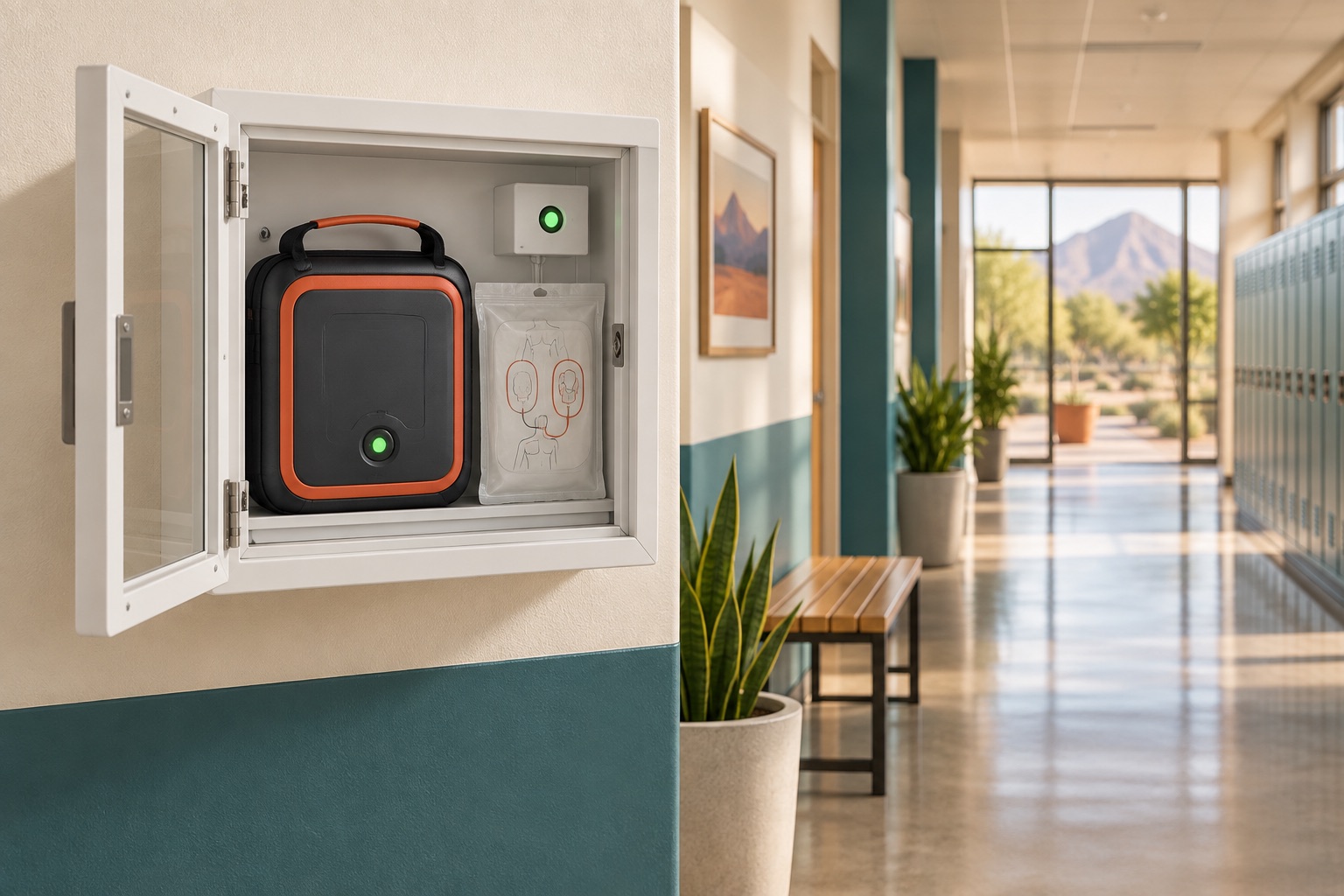
You may have walked past a wall cabinet marked with a heart and lightning bolt without knowing what is inside. An AED, or automated external defibrillator, is a portable medical device designed to help treat sudden cardiac arrest.
The AED analyzes the person’s heart rhythm and decides whether a defibrillation shock is appropriate. It does not shock everyone, and the person using it does not have to interpret the heart rhythm.
Read the video transcript
Cardiac arrest can happen anywhere. An AED gives clear, step-by-step instructions and can deliver a lifesaving shock before emergency responders arrive. LP Health Directions helps businesses, schools, churches and organizations put the right AED program in place, because every second matters.
What does AED stand for?
- Automated: The device analyzes the heart rhythm and determines whether a shock is appropriate.
- External: Adhesive electrode pads connect the device to the outside of the person’s chest.
- Defibrillator: When the AED identifies a shockable rhythm, it can deliver a controlled electrical shock intended to interrupt the dangerous electrical activity.
Public-access AEDs provide spoken and visual prompts. They are designed so people outside a hospital can use them while emergency help is on the way.
What does an AED actually do?
After compatible pads are connected, the AED reads the heart’s electrical activity. Its software looks for certain dangerous rhythms that may respond to defibrillation. If it identifies a shockable rhythm, the AED either tells the user to press a shock button or delivers the shock automatically, depending on the model.
If the device does not identify a shockable rhythm, it will not advise or deliver a shock. That is an important point: an AED is not a universal switch that shocks every person in cardiac arrest.
Cardiac arrest is not the same as a heart attack
Sudden cardiac arrest occurs when the heart suddenly stops pumping blood effectively. The person becomes unresponsive and is not breathing normally. It is an immediate emergency.
A heart attack generally involves blocked blood flow to part of the heart. A heart attack can sometimes lead to cardiac arrest, but the two terms do not mean the same thing. An AED is designed to analyze the rhythm during cardiac arrest. It does not remove a blockage or treat the underlying cause of a heart attack.
How do CPR and an AED work together?
CPR and an AED serve different but connected purposes. CPR helps move blood while the heart is not pumping effectively. The AED evaluates whether the heart rhythm can be treated with defibrillation and provides a shock when appropriate.
An AED does not replace CPR, and CPR does not replace an available AED when a shockable rhythm is present. Calling 911, starting CPR, using an AED promptly and continuing until emergency professionals take over are connected parts of the response.
This article explains the device but is not a CPR or AED lesson. Hands-on training lets people practice the response, use training equipment and receive instructor feedback.
What is part of an AED system?
The complete system includes more than the visible machine. It depends on a working battery, compatible electrode pads and any model-specific cables, connectors or pediatric accessories.
Pads and batteries are not interchangeable. A replacement that looks similar may not fit or operate with the device. Owners should use the exact manufacturer-approved supplies identified for their AED.
Fully automatic and semi-automatic AEDs
Both types analyze the rhythm and decide whether a shock is appropriate. A semi-automatic AED tells the user when to press the shock button. A fully automatic AED gives warnings and then delivers the shock without the user pressing that button.
Neither design asks the user to decide whether the heart should be shocked. The best choice depends on the organization, setting and response plan.
Can an AED be used on a child?
Many AEDs offer pediatric pads, a child setting or another way to reduce the energy delivered for younger patients. The design and supported age or weight ranges vary by model.
Schools, childcare programs and other organizations that serve children should make pediatric capability part of the purchasing decision and verify the manufacturer’s instructions and compatible accessories for the exact device.
An AED must be ready before it is needed
An AED cannot help if no one can find it, the battery is depleted or the pads are missing, damaged or expired. Ownership should include a simple readiness plan that covers visible placement, assigned inspections, status checks, expiration dates, compatible replacements and staff training.
Buying the device is the beginning of AED readiness, not the end.
How LP Health Directions can help
LP Health Directions helps schools, churches, workplaces and community organizations choose and maintain practical AED programs. We can:
- provide a complimentary assessment of existing AEDs, pads and batteries;
- arrange a free site visit to discuss how many devices may be appropriate and where they should be placed;
- help compare AEDs, compatible accessories, cabinets, signs, purchasing and leasing options;
- provide AED management with monthly inspections, physician oversight and replacement support; and
- provide CPR, AED and first-aid training for individuals and groups.
Explore AED Solutions, plan group training or contact LP Health Directions for help with an AED program.
Sources
- U.S. Food and Drug Administration, Automated External Defibrillators
- U.S. Food and Drug Administration, How AEDs in Public Places Can Restart Hearts
- Centers for Disease Control and Prevention, About Cardiac Arrest
- American Heart Association, Treatment of Cardiac Arrest
Reviewed September 13, 2026. This article provides general education and does not replace CPR and AED training, manufacturer instructions, 911 guidance or professional emergency care.