

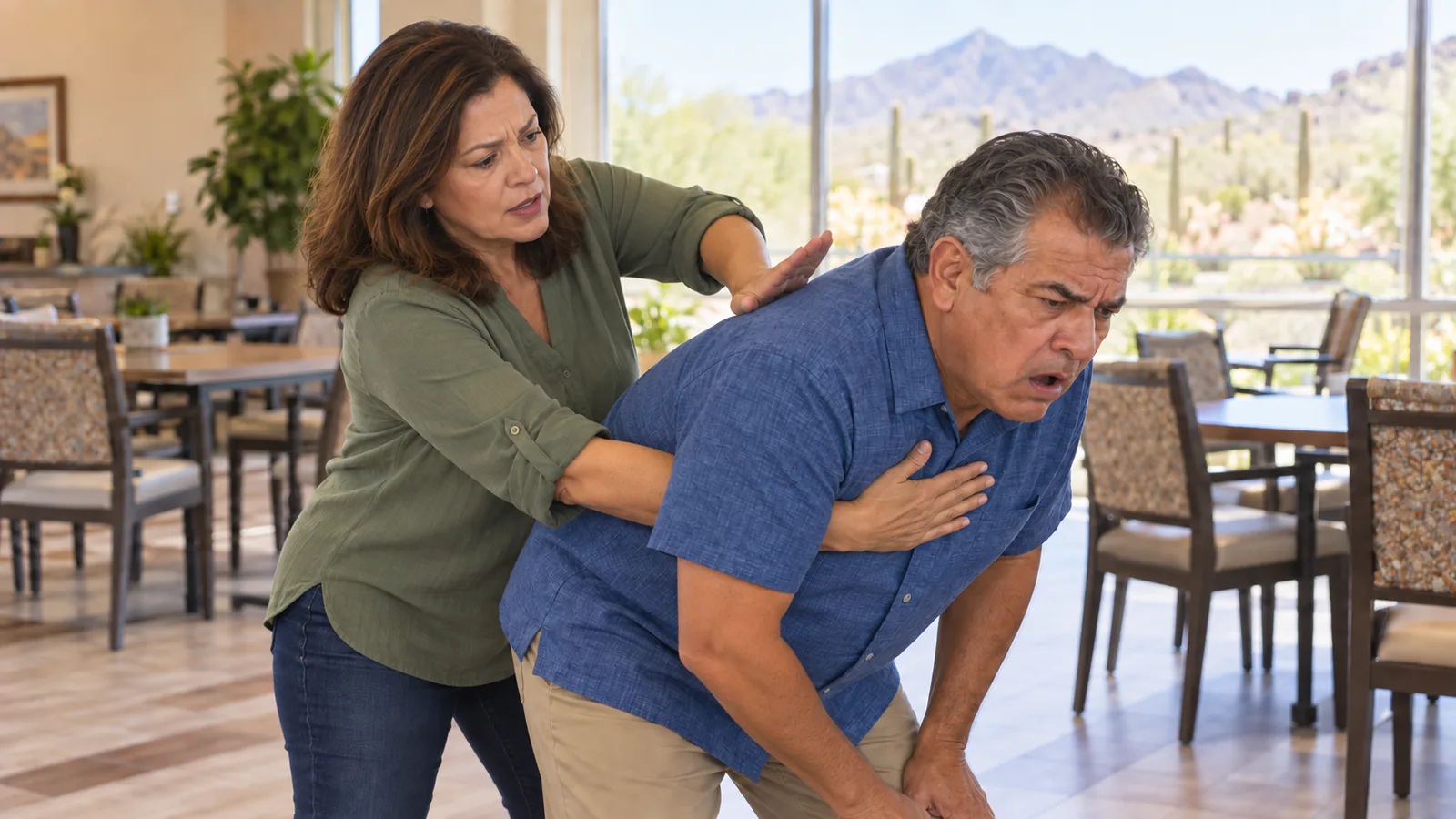
If a choking person can cough or talk, let them keep coughing. If they can’t breathe, talk, or cough, act now. For an adult or child, give 5 back blows between the shoulder blades, then 5 abdominal thrusts, and repeat until the object comes out.
Infants need different steps: 5 back blows and 5 chest thrusts, never abdominal thrusts. If you care for young children or older adults at a daycare, school, or church, these are skills worth knowing well.
What changed in the choking steps?
Under the 2025 American Heart Association (AHA) Guidelines, the steps for adults and children start with 5 back blows, then 5 abdominal thrusts. You keep alternating until the object comes out or the person becomes unresponsive.
If you learned “the Heimlich” years ago, abdominal thrusts are still part of it. What changed is the order: back blows come first.
A strong cough is not the same as a blocked airway
Not every choking person needs back blows. The question is whether air is still moving.
Mild blockage: the person can breathe, talk, make sounds, or cough loudly. A strong cough is doing the work. Stay with them, encourage them to keep coughing, and call 911 if you are worried. Do not hit their back or give thrusts while a strong cough is working.
Severe blockage: the person can’t breathe, talk, cough, or cry, or makes no sound at all. You may see:
- A face changing color
- Watery eyes or drooling
- Hands at the throat, the universal choking sign
A silent child at the lunch table is more worrying than a loud, coughing one. If a cough becomes weak or silent, treat it as a severe blockage and act.
How do you help a choking adult or child?
- Ask, “Are you choking? Can I help?” If they nod, act. Have someone call 911 and get an AED.
- Get in position. Stand or kneel behind them with one foot ahead of the other. Put one hand on their shoulder and lean them forward.
- Give 5 back blows between the shoulder blades with the heel of your other hand. Make each one firm.
- Give 5 abdominal thrusts. Make a fist and place it, thumb side in, just above the belly button and well below the breastbone. Grab your fist with your other hand and thrust in and up.
- Keep alternating 5 back blows and 5 abdominal thrusts until the object comes out and they can breathe, cough, or talk, or until they become unresponsive.
For a small child, kneel behind them so you are at their height.
What if the person is pregnant, large, or in a wheelchair?
If you can’t get your arms around the waist, or the person is pregnant, give chest thrusts instead of abdominal thrusts. Think of an older adult in a wheelchair at a church meal.
- Put your arms under their armpits.
- Place your fist on the lower half of the breastbone.
- Pull straight back.
How do you help a choking infant?
An infant is a baby under 1 year old. Have someone call 911, then:
- Position the infant face down along your forearm, supporting the head and jaw with your hand. Rest your forearm on your thigh, with the infant’s head lower than the body.
- Give 5 firm back blows between the shoulder blades with the heel of your hand.
- Turn the infant face up. Sandwich them between your forearms, support the head, and turn them over, keeping the head lower than the chest.
- Give 5 chest thrusts with the heel of one hand on the lower half of the breastbone, just below the nipple line, about one per second.
- Repeat until the object comes out or the infant becomes unresponsive.
Never give abdominal thrusts to an infant. They can cause serious injury. The turn is the hardest part. Sitting with your forearm on your thigh helps you keep control.
What if they become unresponsive?
- Lower them to a firm surface. Have someone call 911 and get an AED.
- Start CPR, beginning with chest compressions.
- After each set of 30 compressions, look in the mouth before giving breaths. Remove the object only if you can see it.
Never do a blind finger sweep, reaching into the mouth for something you can’t see. It can push the object deeper. For the full steps, see How to Do CPR.
Do they need to see a doctor afterward?
Yes. Anyone who has had a severe choking episode should see a health care professional, even if they seem fine once the object is out.
This article is general education. It does not replace hands-on CPR and first aid training, where you practice these skills with an instructor.
How LP Health Directions can help
In class, you practice back blows and thrusts on manikins until the steps feel natural.
- CPR and First Aid classes in Phoenix and Tucson.
- On-site Group Training for daycares, schools, churches, and workplaces.
- For parents and caregivers of babies, read Infant CPR Classes for Parents and Caregivers.
- Ready to learn? Book a class or browse the full First Aid Guide.
Sources
- American Heart Association, Updated CPR guidelines tackle choking response, opioid-related emergencies and a revised Chain of Survival
- American Heart Association, Updated CPR guidelines released for pediatric and neonatal emergency care and resuscitation
- American Heart Association, 2025 Guidelines for CPR and Emergency Cardiovascular Care
- American Red Cross, Adult and Child Choking
Reviewed September 28, 2026. This article provides general education and does not replace first aid and CPR training, medical advice, or 911 guidance.