

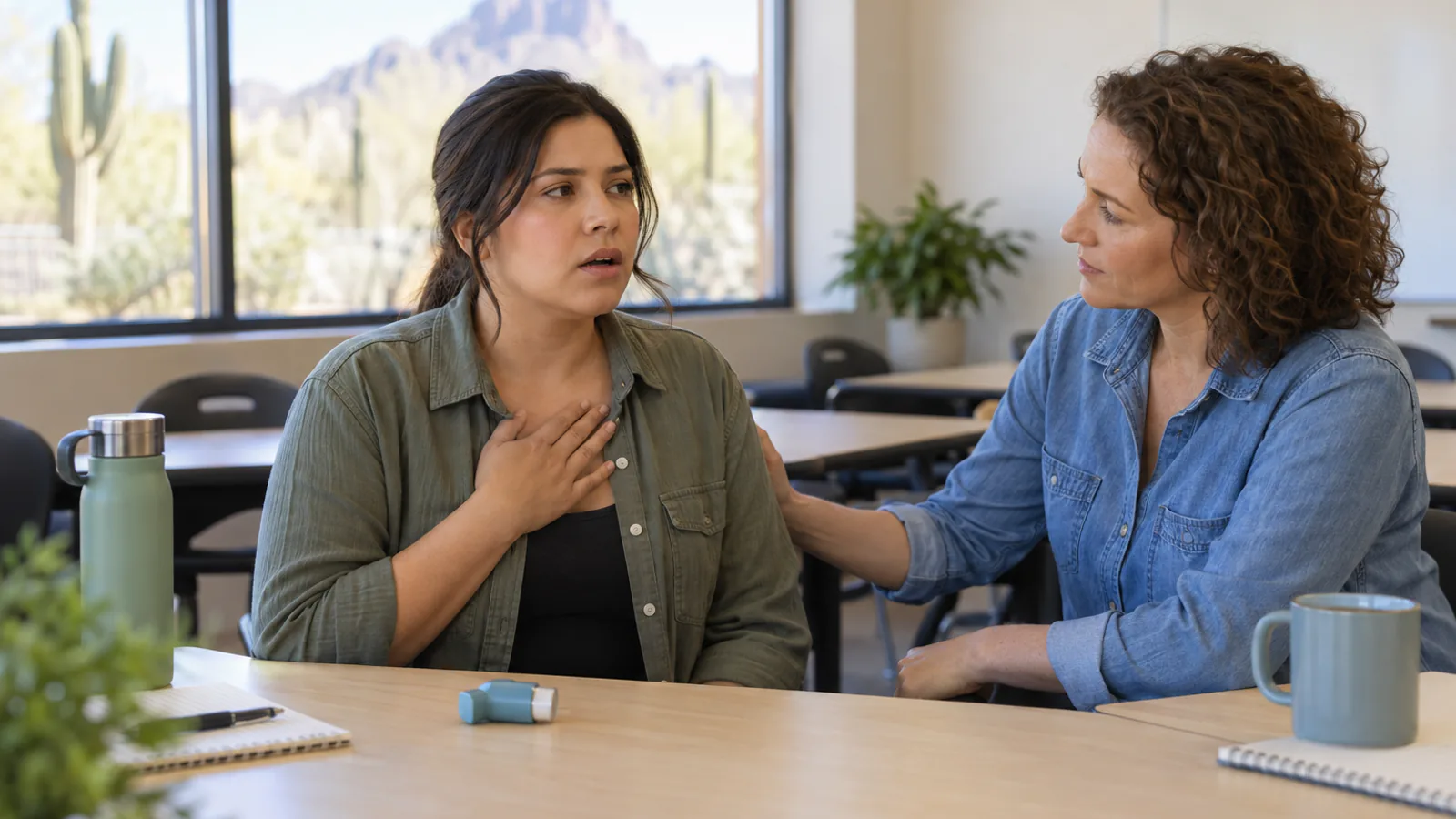
During an asthma attack, help the person use their own rescue inhaler, usually 2 puffs, and keep them calm. Call 911 if they have no inhaler, are not improving, or can’t speak.
In a daycare, school, or church, the person having the attack is often a child, and a frightened child breathes harder. Your calm voice is part of the first aid.
What does an asthma attack look like?
Look for:
- Wheezing or noisy breathing
- Coughing
- Fast or slow breathing, with effort on every breath
- Being able to say only a few words at a time
- Pale, bluish, or gray skin, or bluish lips
How do you help someone having an asthma attack?
Ask, “Do you need help? Do you have medicine?” Then help them use their own rescue inhaler. Your job is to help them use it and stay with them.
If they can only nod, point, or get out a word or two, their breathing is in serious trouble. Have someone call 911 now while you help with the inhaler.
Keep them calm, especially children. Crying makes breathing harder. Get down to a child’s eye level, speak slowly and softly, and stay close. Tell them what you are doing before you do it, and praise each slow breath.
If you work with children, follow your workplace medication policy and the child’s care plan. If a parent or guardian is there, include them.
How do you help someone use an inhaler?
- Get it ready. Remove the cap and shake the inhaler. Attach the spacer if there is one.
- Breathe out. Have them breathe all the way out. This is hard during an attack, so just do your best.
- Seal the lips. Put the mouthpiece between their teeth with their lips sealed around it.
- Press and breathe in. Press the canister once as they start to breathe in, and have them breathe in slowly and deeply.
- Hold the breath for up to 10 seconds.
- Repeat for each puff prescribed, usually 2. Replace the cap.
When should you call 911 for asthma?
Call 911 and send someone for an AED if the person:
- Has no inhaler or other medicine
- Gets worse, or doesn’t improve after using the inhaler
- Has trouble speaking
- Becomes unresponsive
Stay with them until EMS arrives. If they become unresponsive and are not breathing normally, start CPR and use the AED. See How to Do CPR. And when in doubt, call. You never need to be sure it is serious.
An asthma attack is not the same as a severe allergic reaction
Both can make it hard to breathe, and both can become serious. But they are different problems with different medicines.
- Asthma attack: wheezing, coughing, and struggling to breathe. The medicine is the person’s rescue inhaler.
- Severe allergic reaction (anaphylaxis): trouble breathing along with signs like a swollen tongue or face, a fast heartbeat, or dizziness, often after a food, medicine, or insect sting. The medicine is the person’s epinephrine auto-injector, given in the outer thigh.
Hives, swelling of the face or tongue, or a known trigger like a food or bee sting point toward an allergic reaction. If you see those signs, follow the steps in Severe Allergic Reaction and How to Use an Epinephrine Auto-Injector. If you are not sure which one you are seeing, call 911.
What should daycare and school staff know?
Daycares and schools often keep children’s inhalers in the office. Find out now where they are stored and who can get to them quickly. In an emergency, send one person for the inhaler while another stays with the child. Every minute spent searching for medicine is a minute of hard breathing.
This article is general education. It does not replace hands-on CPR and first aid training, where you practice these skills with an instructor.
How LP Health Directions can help
Our classes cover asthma, allergic reactions, and other breathing emergencies alongside CPR and AED skills.
- CPR and First Aid classes in Phoenix and Tucson.
- On-site Group Training for daycares, schools, churches, and workplaces.
- Ready to learn? Book a class or browse the full First Aid Guide.
Sources
- American Heart Association, 2025 Guidelines for CPR and Emergency Cardiovascular Care
- American Red Cross, Learn First Aid
Reviewed September 28, 2026. This article provides general education and does not replace first aid and CPR training, medical advice, or 911 guidance.