

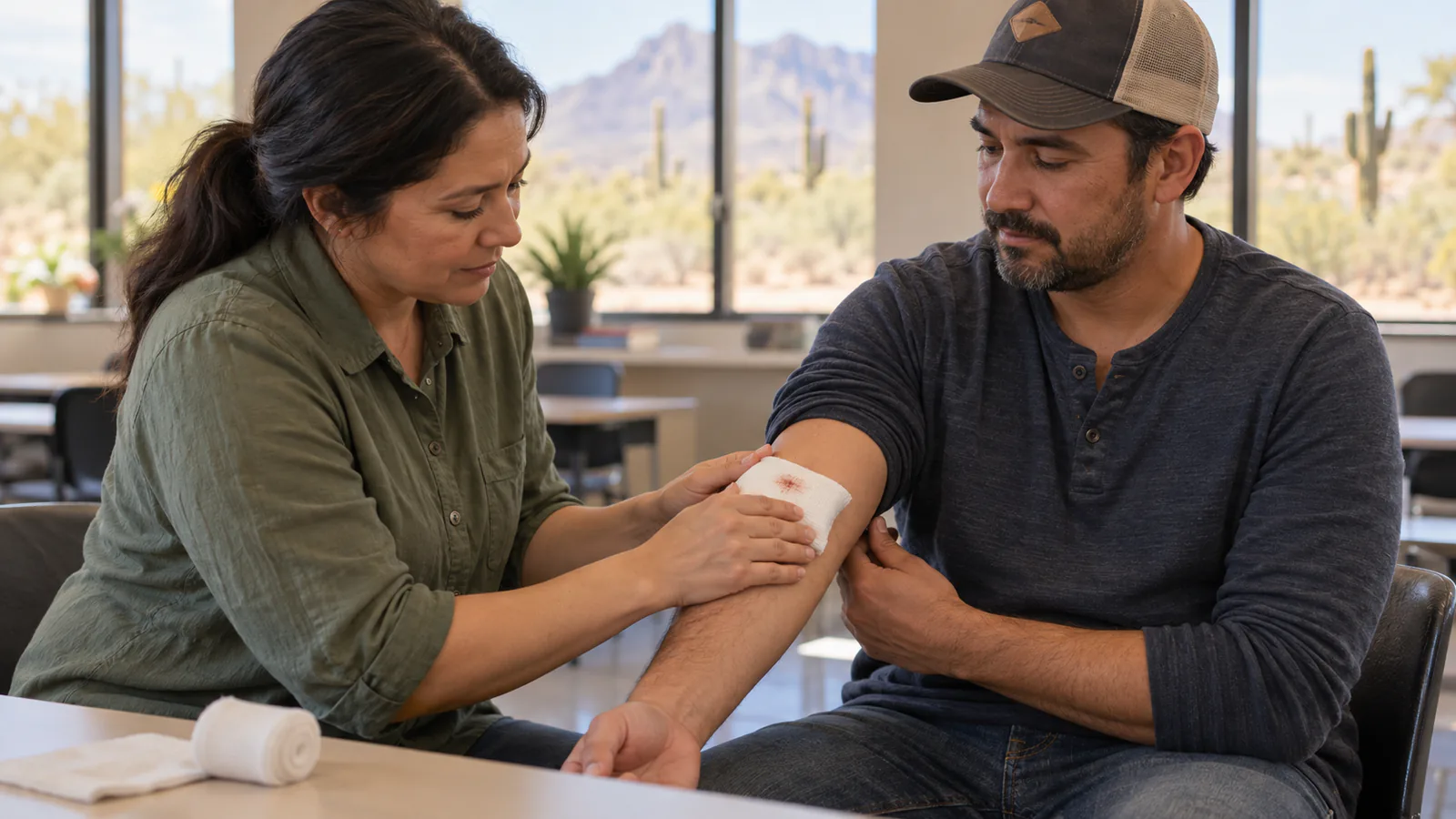
To stop severe bleeding, press hard on the wound with both hands and don’t let up. If pressure alone isn’t working, pack a deep wound with gauze, and for an arm or leg, use a tourniquet. Call 911 right away for any heavy bleeding.
Speed matters. The U.S. Department of Homeland Security notes that a person who is bleeding can die from blood loss within five minutes. The person standing next to them is the one who can stop it.
Minor bleeding is not the same as life-threatening bleeding
Most cuts and scrapes in a classroom or nursery are minor. They ooze or bleed slowly and stop with a little pressure. Life-threatening bleeding looks different, and it needs a different response.
Minor bleeding: put on gloves, wash the wound with soap and water, press a dressing on until the bleeding stops, then cover it with a bandage. Deep, gaping, or dirty wounds still need medical care, possibly for stitches or a tetanus shot.
Severe bleeding: a steady, continuous flow, or a large amount of blood. A useful picture is about 6 ounces, roughly half a soda can, or more. That is when you call 911 and move fast.
People on blood thinners, including aspirin, bleed more. Many older adults take them, so be ready for more bleeding than you expect from a fall or a cut at church or a senior program.
What are the steps to stop severe bleeding?
- Stay safe and put on gloves. Check the scene first. Treat all blood as if it could carry infection.
- Alert. Call 911 and send someone for the first aid kit or bleeding control kit.
- Find the source. Look for the biggest source of active bleeding.
- Apply direct pressure. Put a dressing on the wound, using a hemostatic dressing if your kit has one. Place one palm on top, put your other hand on that hand, and press hard and steady.
- Don’t lift. Don’t peek to check the wound or swap the dressing. If blood soaks through, add more dressing on top and press harder.
When should you pack a wound?
Pack the wound if pressure alone isn’t working, especially for a deep wound. Press gauze or clean cloth tightly into the wound, filling the space, then keep pressing firmly on top.
How do you use a tourniquet?
A tourniquet is for an arm or leg when direct pressure isn’t enough to stop life-threatening bleeding.
- Place it about 3 inches above the wound, on the side closer to the heart.
- Never place it on a joint, like the elbow or knee.
- Pull the strap tight, then twist the windlass (the rod) until the bleeding stops.
- Lock the windlass in place.
- Write down the time you applied it.
It will hurt. That’s expected, and it is not a reason to loosen it. If one tourniquet doesn’t stop the bleeding, add a second one above the first.
Leave the tourniquet on for EMS, and tell them what time it went on.
Most people don’t tighten a tourniquet enough the first time. That’s one reason it helps to practice with a trainer tourniquet in class before you ever need a real one.
What if an object is stuck in the body?
Leave it in. Only a health care professional should remove it. Pulling it out can cause more bleeding or more damage.
Press around the object, not on it, and keep the person still. A wound to the torso or upper leg may be bleeding more inside the body than you can see, so call 911 and watch closely for signs of shock, such as a fast heartbeat, confusion, and pale, cool, or sweaty skin.
What should you do with an amputated part?
Take care of the person first. Control the bleeding with pressure or a tourniquet, and don’t delay care to search for the part.
Once the bleeding is controlled:
- Find the part and rinse it with clean water.
- Pat it dry and wrap it loosely in a clean, damp dressing.
- Seal it in a watertight plastic bag.
- Write the person’s name, the date, and the time on the bag.
- Set the bag in a container of ice and water.
Never put the part directly on ice or directly in water. Make sure it goes to the hospital with the person.
Does your workplace have a bleeding control kit?
A bleeding control kit is built for the kind of bleeding a basic first aid kit can’t handle. For a school, church, or daycare, it belongs in the same plan as your first aid kit and AED.
Know where yours is before you need it. In an emergency, point at one person and say, “You, get the bleeding control kit,” so no one assumes someone else went.
This article is general education. It does not replace hands-on CPR and first aid training, where you practice these skills with an instructor.
How LP Health Directions can help
Every first aid class we teach includes bleeding control, with hands-on practice so direct pressure and tourniquet use feel familiar.
- CPR and First Aid classes at our Phoenix and Tucson Training Sites.
- On-site Group Training for daycares, schools, churches, and workplaces.
- First Aid Solutions, including bleeding control kits and first aid kits for your site.
- Related reading: first steps in a medical emergency and when to call 911.
- Book a class or contact us to train your team.
Sources
- U.S. Department of Homeland Security, Stop the Bleed
- American College of Surgeons, Stop the Bleed
- American Red Cross, Life-Threatening External Bleeding
- American Heart Association, 2025 Guidelines for CPR and ECC
Reviewed September 28, 2026. This article provides general education and does not replace first aid and CPR training, medical advice, or 911 guidance.