

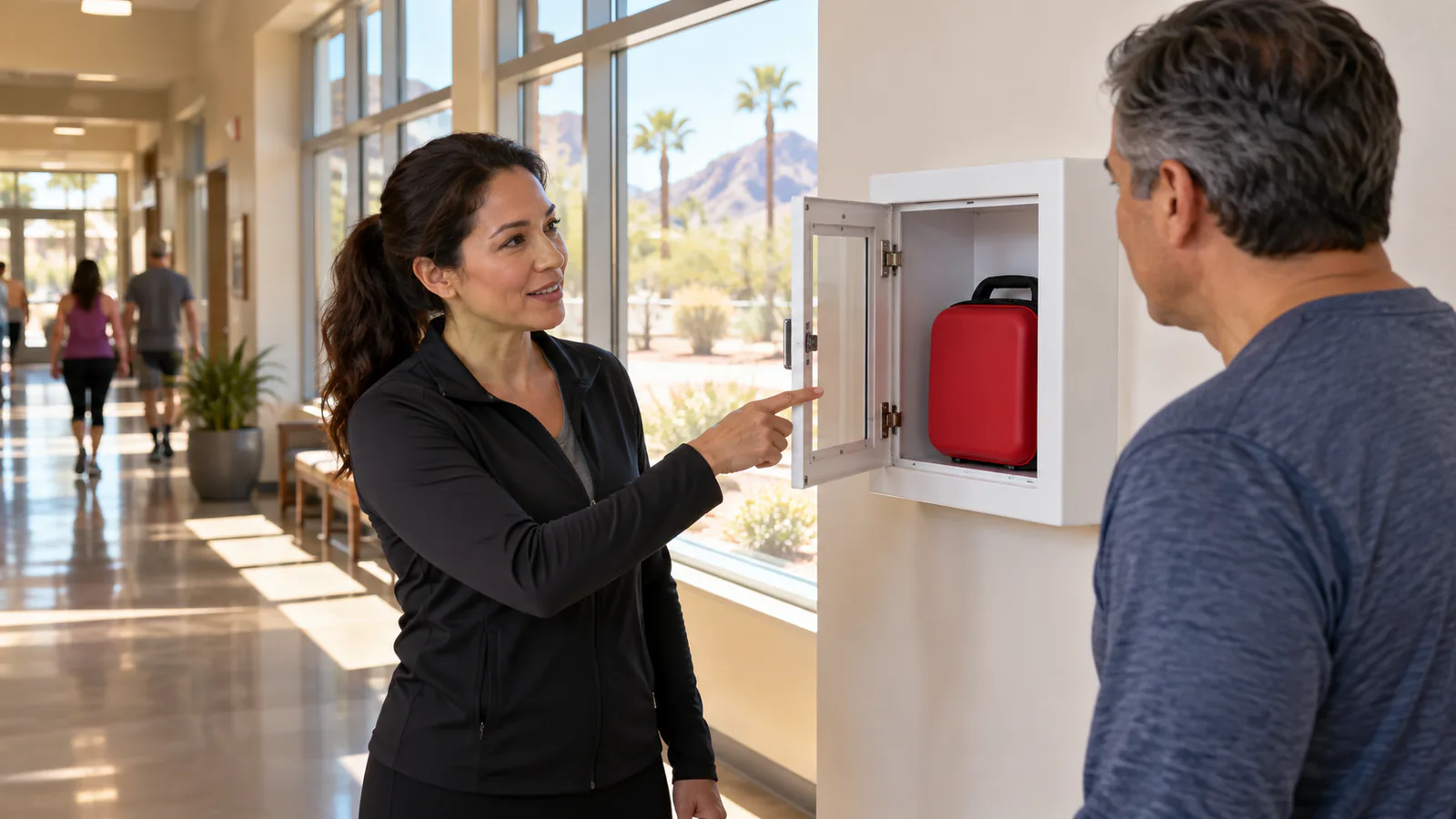
Using an AED is simpler than most people expect. You turn it on, follow the voice prompts, put the pads on the person’s bare, dry chest, and stay clear while it checks the heart rhythm. The AED decides whether a shock is needed. You do not.
Even so, many people hesitate. In 2024, a bystander used an AED in only about 13% of U.S. cardiac arrests outside the hospital. For how the device works, see What Is an AED and What Does It Actually Do?
When should you use an AED?
Use an AED for anyone who is unresponsive and not breathing normally, or only gasping. Gasping is not breathing.
It works on anyone in cardiac arrest, at any age, even if pregnant. It only shocks if a shock is needed, so you cannot hurt the person by using it.
How do you use an AED?
- Turn it on. Some AEDs turn on when you open the lid. Follow the voice prompts.
- Place the pads. Expose the chest and put the pads on bare, dry skin exactly as pictured on the pads. Plug in the connector if needed. The AED will tell you if the pads are not making good contact.
- Let it analyze. Say “Clear!” and make sure no one is touching the person.
- Shock if advised. Say “Clear!” again and check that everyone is back before you press the shock button. A fully automatic AED counts down and shocks on its own, so everyone stays clear.
- Restart CPR right away, starting with compressions, whether or not a shock was given. The AED rechecks every 2 minutes.
- Keep going until EMS takes over or the person starts to respond. If they start breathing, leave the pads on and leave the AED turned on.
With two rescuers, one keeps doing compressions while the other places the pads. Keep pauses under 10 seconds. For the full CPR steps, see How to Do CPR.
Can you use an AED on a child or infant?
Yes. For children under 8 years old, including infants:
- Use child pads, or turn the child key or switch if the AED has one.
- If there is no child option, use adult pads. A shock from adult pads is better than no shock.
- If the pads would touch each other on a small chest, place one pad on the center of the chest and the other on the center of the back.
The rule is based on age, not weight: under 8, child pads.
If you work in a daycare, preschool, or church nursery, check this week whether your AED has child pads or a child key, and where they are kept.
What about hairy chests, pacemakers, and other special situations?
- Hairy chest: Pads must touch skin. Shave the pad areas with the razor in the AED kit. No razor but two sets of pads? Press the first set on firmly, rip it off to remove hair, then apply the second.
- Pacemaker or implanted defibrillator: Look for a lump under the skin, usually on the upper chest. Place the pad beside it, not on top. A pad over the device can block the shock.
- Medicine patch: With gloves on, remove it and wipe the skin.
- Jewelry: Move it aside or place the pad next to it. It does not need to come off.
- Bra or undergarments: Move or remove anything covering the pad locations. This is not the time for modesty.
- Water, sweat, snow, or metal: Get the person out of standing water and wipe the chest dry. An AED is safe in a puddle, in snow, or on metal as long as the chest is dry. Water on the chest can carry the current away from the heart.
- Pregnancy: Use the AED normally. Saving the mother is the best way to save the baby.
After a pool emergency, get the person completely out of the water and dry the chest first. See What to Do When Someone Is Drowning.
“No shock advised” is not the same as “the person is OK”
When the AED says “No shock advised,” it means the heart rhythm is not one a shock can fix. It does not mean the heart is working or the person is recovering.
A rescuer who hears “no shock” may stop, thinking the danger has passed. Don’t. Restart compressions right away and follow the prompts. The AED checks again every 2 minutes and will advise a shock if one is needed then. Stop only when EMS takes over or the person starts to respond.
Can you get in trouble for using an AED?
Arizona law protects people who use an AED in good faith to help someone in an emergency. See Arizona’s Good Samaritan Law and First Aid.
Where can you find an AED?
Schools, churches, gyms, airports, and many workplaces have them. Find the nearest one to where you work this week, and make sure your coworkers know too.
This article is general education. It does not replace hands-on CPR and first aid training, where you practice these skills with an instructor.
How LP Health Directions can help
In class, you practice with a trainer AED while a partner does compressions.
- CPR and First Aid classes at our Phoenix and Tucson Training Sites.
- On-site Group Training for daycares, schools, churches, and workplaces.
- AED Solutions for AED sales, leasing, and management.
- Ready to learn? Book a class or browse the full First Aid Guide.
Sources
- American Heart Association, Top Takeaways from the 2026 Heart Disease and Stroke Statistics Update
- American Heart Association, How to Use an AED
- American Heart Association, 2025 Guidelines for CPR and Emergency Cardiovascular Care
- U.S. Food and Drug Administration, Automated External Defibrillators (AEDs)
- Arizona State Legislature, A.R.S. § 36-2263
Reviewed September 28, 2026. This article provides general education and does not replace first aid and CPR training, medical advice, or 911 guidance.