

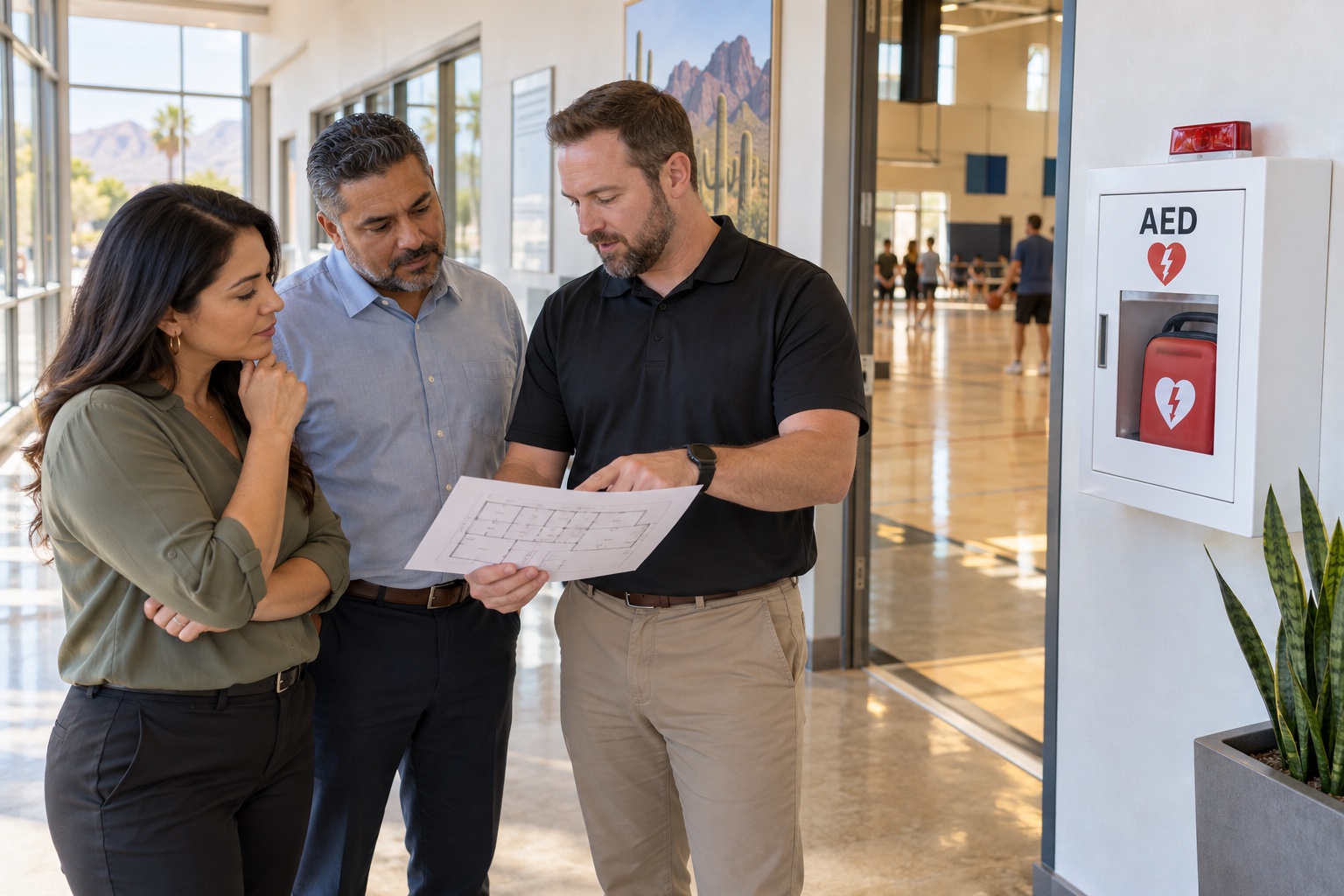
Many organizations begin with one question: “Are we required to have an AED?” That matters, but it is not the only question worth asking.
A practical decision also considers who uses the property, how quickly an automated external defibrillator can reach each occupied area and whether the organization can keep the device ready. An AED can be an important part of the response to sudden cardiac arrest, but only when people can find it, reach it and use it while emergency help is on the way.
What an AED adds to an emergency response
An AED analyzes the heart rhythm of a person in cardiac arrest. It delivers or advises a shock only when it identifies an appropriate shockable rhythm. The device does not replace calling 911, CPR or professional care.
The FDA explains that defibrillation is time-sensitive. Emergency medical services remain essential, but an AED already inside a building may be available before responders arrive. That is the reason organizations evaluate AED access, not because the device can solve every medical emergency.
For a plain-language explanation of the device, read What Is an AED and What Does It Actually Do?
Which organizations should evaluate AED access?
There is no single answer for every property. Schools, churches, workplaces, gyms, childcare programs, senior programs, event venues and community organizations all use their spaces differently.
An AED review is especially useful when a property has:
- several floors, buildings, fields or parking areas;
- physical activity, athletic events or large gatherings;
- visitors in addition to employees;
- evening or weekend programs;
- locked doors, gates or other access barriers; or
- areas that emergency responders may need extra time to reach.
This does not mean every organization has the same legal requirement. Requirements vary by setting and jurisdiction. Arizona public high schools with athletic programs, for example, have a specific state law addressed in our article about Arizona’s high-school AED requirements. Organizations should confirm the rules that apply to them rather than relying on a general article for a compliance decision.
Ask whether the AED can be reached quickly
A device in the building is not necessarily an accessible device. Walk the real route from the proposed cabinet to the places where people work, gather or exercise.
Consider:
- Can visitors and staff see the cabinet?
- Is the AED available during every shift, service, practice and event?
- Do stairs, locked doors or security procedures slow retrieval?
- Are separate buildings or outdoor areas too far from one device?
- Do regular staff and volunteers know where it is?
- Does the organization serve children who may require model-specific pediatric capability?
A head count alone cannot answer these questions. The property layout and operating schedule matter just as much.
Buying the AED is only the beginning
An AED program needs an owner. Someone should be responsible for checking the device, responding to warning indicators, tracking pad and battery expiration dates, keeping compatible replacements available and making sure the cabinet and signs remain visible.
The plan should also address staff training, 911 activation, access during special events, manufacturer notices and replacement supplies after a use. OSHA recommends that workplace AEDs be used, inspected, tested and maintained according to the manufacturer’s specifications.
How LP Health Directions can help
LP Health Directions helps organizations move from a general interest in AEDs to a workable plan. We offer:
- a complimentary assessment of existing AEDs, pads and batteries;
- a free site or campus visit to discuss device quantity and placement;
- AED purchasing and leasing options;
- compatible pads, batteries, cabinets, signs and responder supplies;
- AED management with monthly inspections and physician oversight;
- battery and pad replacement through the management program when needed; and
- discounted CPR and First Aid training for managed-program clients.
The goal is not to give every organization the same answer. It is to match the equipment, placement and ongoing responsibilities to the way the property is actually used.
Explore AED Solutions, plan group training or contact LP Health Directions to discuss your organization.
Sources
- U.S. Food and Drug Administration, How AEDs in Public Places Can Restart Hearts
- U.S. Food and Drug Administration, Automated External Defibrillators
- Occupational Safety and Health Administration, AEDs in the Workplace
- Occupational Safety and Health Administration, First Aid Kits and Automated External Defibrillators, Non-Mandatory Appendix
Reviewed September 13, 2026. This article provides general planning information and does not replace manufacturer instructions, emergency guidance, medical advice or legal advice.