

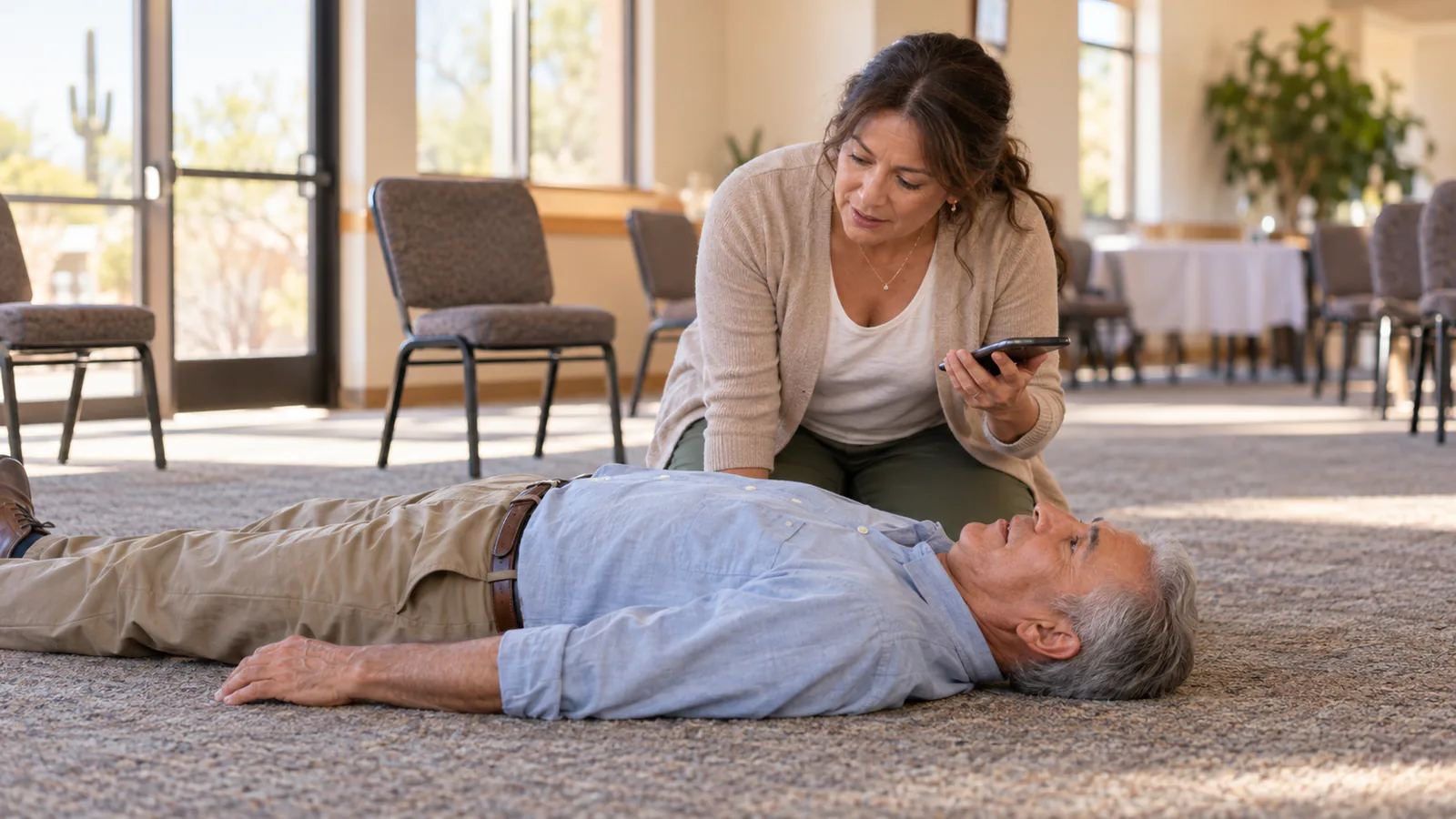
If someone faints, help them lie flat on their back. If they feel dizzy but have not passed out, have them sit and lean forward with their head toward their knees. When they feel better, let them get up slowly.
Most people who faint wake up within a minute or so. Call 911 if they stay unresponsive for more than 1 minute, faint again, or keep feeling dizzy. And if they are not breathing normally, this is not a faint. Start CPR.
Why do people faint?
Fainting happens when not enough blood reaches the brain for a moment. The person briefly loses consciousness, then comes back around.
Common triggers include:
- Standing still for a long time, especially in the heat
- Standing up quickly after sitting, kneeling, or bending over
- Low blood sugar
- Dehydration
- A medical condition
Think of a volunteer standing in the sun at an outdoor church event, or a grandparent standing up too fast after a long service. In an Arizona summer, heat and dehydration make fainting more likely.
What should I do right after someone faints?
Make sure the area is safe, then:
- Keep them lying flat on their back.
- Check responsiveness. Tap their shoulder and ask loudly, “Are you OK?”
- Check breathing. Watch the chest for 5 to 10 seconds. You are looking for normal breathing, not occasional gulps.
- Look for injuries. People who faint often fall. Check for a bump on the head, bleeding, or pain.
If you think they hit their head or hurt their neck or back when they went down, do not move them. Keep them still and call 911. Our article on head, neck, and spine injuries explains what to watch for.
When they wake up and feel normal, help them sit up slowly, and stay with them.
What if they feel faint but have not passed out?
If someone says they feel dizzy or lightheaded, act before they fall:
- Have them sit and lean forward with their head toward their knees, or lie down flat.
- Do not let them get up quickly, even if they say they are fine.
- Stay close so you can help lower them to the floor if they start to go down.
When should I call 911 for fainting?
Call or text 911 if:
- They are unresponsive for more than 1 minute
- They faint more than once
- They keep feeling dizzy
- They are not breathing normally (start CPR right away)
- They hurt their head, neck, or back in the fall
When in doubt, call.
Ask what led up to it. If they have diabetes and seem confused or shaky, low blood sugar may be the cause; see our guide to low blood sugar first aid. If they were out in the heat and are confused or acting strangely, treat it as a heat emergency; see heat stroke and heat exhaustion first aid.
Fainting is not the same as cardiac arrest
At first, the two can look alike: someone collapses and does not respond. What happens next is very different.
Someone who faints is still breathing normally and usually wakes up within a minute or so. Someone in cardiac arrest is not breathing normally, or is only gasping. Their heart has stopped pumping blood. They will not wake up on their own.
A person in cardiac arrest may also jerk or twitch briefly as they collapse, which can look like a seizure. If they are not breathing normally afterward, it is cardiac arrest, and they need CPR.
The test is simple: check breathing. If they are not breathing normally, or you are not sure, start CPR and get an AED. About 350,000 people in the U.S. have a cardiac arrest outside a hospital each year, and about 90% do not survive. Fast bystander CPR gives them a chance; see how to do CPR.
This article is general education. It does not replace hands-on CPR and first aid training, where you practice these skills with an instructor.
How LP Health Directions can help
The hardest part of a faint is telling it from something worse. Practicing the breathing check makes that call easier.
- CPR and First Aid classes in Phoenix and Tucson, based on the 2025 American Heart Association (AHA) Guidelines
- On-site Group Training for daycares, schools, churches, and workplaces
- AED Solutions so your building is ready if a collapse turns out to be cardiac arrest
- More topics in our First Aid Guide, including what to do when someone falls
- Ready to train your team? Book a class or visit our Phoenix or Tucson Training Site.
Sources
- American Heart Association, 2025 Guidelines for CPR and Emergency Cardiovascular Care
- American Heart Association, CPR Facts and Updated Guidelines 2025
- American Heart Association, Hands-Only CPR
- American Red Cross, Learn First Aid
Reviewed September 28, 2026. This article provides general education and does not replace first aid and CPR training, medical advice, or 911 guidance.