

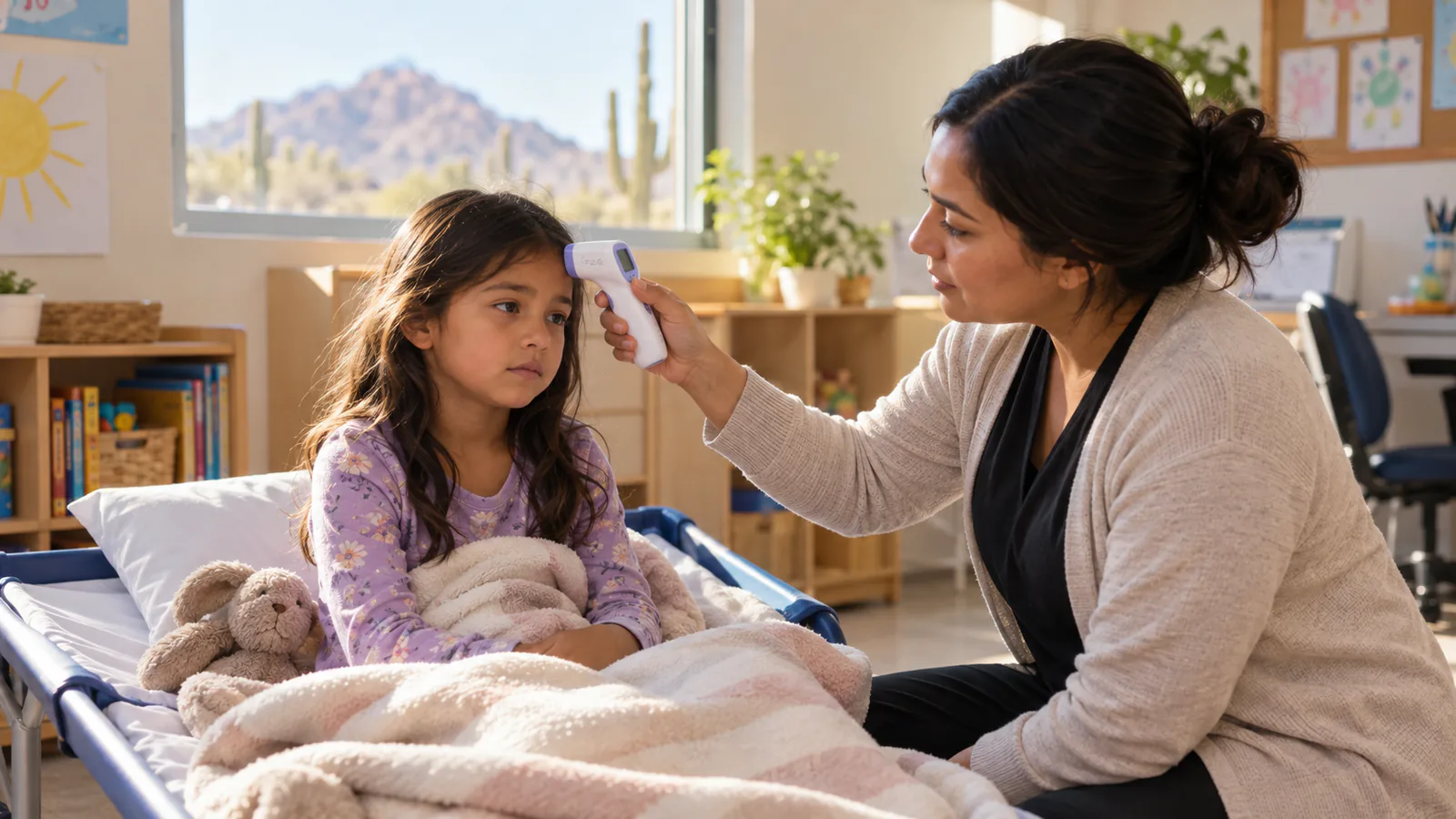
If someone has a fever, take their temperature, keep them comfortable, and keep them away from others. For a child, use a thermometer that isn’t glass, and give fever medicine only with approval from a parent, caregiver, or health care provider.
Never give aspirin to a child with a fever unless a health care provider says to. Call 911 if the person has a seizure, has trouble breathing, is hard to wake up, or shows signs of dehydration or shock.
What causes a fever?
A fever usually comes from an illness or infection.
Less often, a fever can follow a venomous bite or sting. In Arizona, that includes scorpion stings, which can cause fever along with severe pain, muscle cramps, and vomiting. Children are at higher risk from bark scorpion stings. If you think a sting is involved, call Poison Control at 1-800-222-1222, and see our guide to bites and stings first aid.
How should I take a child’s temperature?
Use a thermometer that isn’t glass for children. Keep one in your first aid supplies so you are not searching for it when a child feels warm.
Can I give a child fever medicine at daycare or school?
Only with approval from the child’s parent, caregiver, or health care provider. Daycare and school staff should also follow their program’s medication policy.
For anyone, give fever medicine only as directed on the package or by a health care provider.
If you are not sure what your policy says, find out now, not while a child is sick in the office.
Why can’t you give aspirin to a child with a fever?
Aspirin can cause serious illness in children. Never give aspirin to a child with a fever unless a health care provider tells you to.
This is one of the most important rules in this article. Make sure everyone on your staff knows it.
What else should I do while they wait to be picked up?
- Keep them away from others. A quiet spot in the office, away from the other children, works well.
- Stay with them and watch them. Check on how they are breathing and how alert they are.
- Watch for warning signs. Know the signs of dehydration and shock listed below.
When should I call 911 for a fever?
Call 911 if the person with a fever:
- Has a seizure
- Has trouble breathing
- Is hard to wake up
- Shows signs of dehydration, such as weakness, thirst, dry mouth, chapped lips, dizziness, less urination, or confusion
- Shows signs of shock, such as a fast heartbeat, confusion, light-headedness, or pale, cool, or sweaty skin
If a child has a seizure, time it, ease them to the floor, and cushion their head. Never hold them down or put anything in their mouth. When it stops, roll them onto their side. Our article on seizure first aid explains more.
When in doubt, call. You never need to be sure it’s serious before calling 911.
A fever is not the same as heat illness
Both can make a person feel hot, tired, and unwell, so they are easy to mix up. But they have different causes and need different care.
A fever comes from inside the body, usually from an illness or infection. Heat illness comes from the environment: too much time in the heat, often with too little to drink. In Arizona, that can happen fast on a playground, at recess, or at an outdoor church event.
Heat stroke is an emergency. Watch for confusion, slurred speech, agitation, seizures, or collapse in someone who has been in the heat. Call 911 and start cooling them right away. Don’t wait to take a temperature, and don’t assume it’s “just a fever.”
Learn the signs and steps in our guide to heat stroke and heat exhaustion first aid.
This article is general education. It does not replace hands-on CPR and first aid training, where you practice these skills with an instructor.
How LP Health Directions can help
We train daycare, school, and church staff to handle the everyday emergencies that come with caring for children.
- CPR and First Aid classes in Phoenix and Tucson, based on the 2025 American Heart Association (AHA) Guidelines
- On-site Group Training for daycares, schools, and churches
- First Aid Solutions to stock your office with the right supplies
- Questions about training your team? Book a class or browse our First Aid Guide.
Sources
- American Red Cross, Learn First Aid
- American Red Cross, Seizures
- Centers for Disease Control and Prevention (NIOSH), Heat-related Illnesses
- Arizona Department of Health Services, Heat Safety
- Health Resources and Services Administration, Poison Help
Reviewed September 28, 2026. This article provides general education and does not replace first aid and CPR training, medical advice, or 911 guidance.