

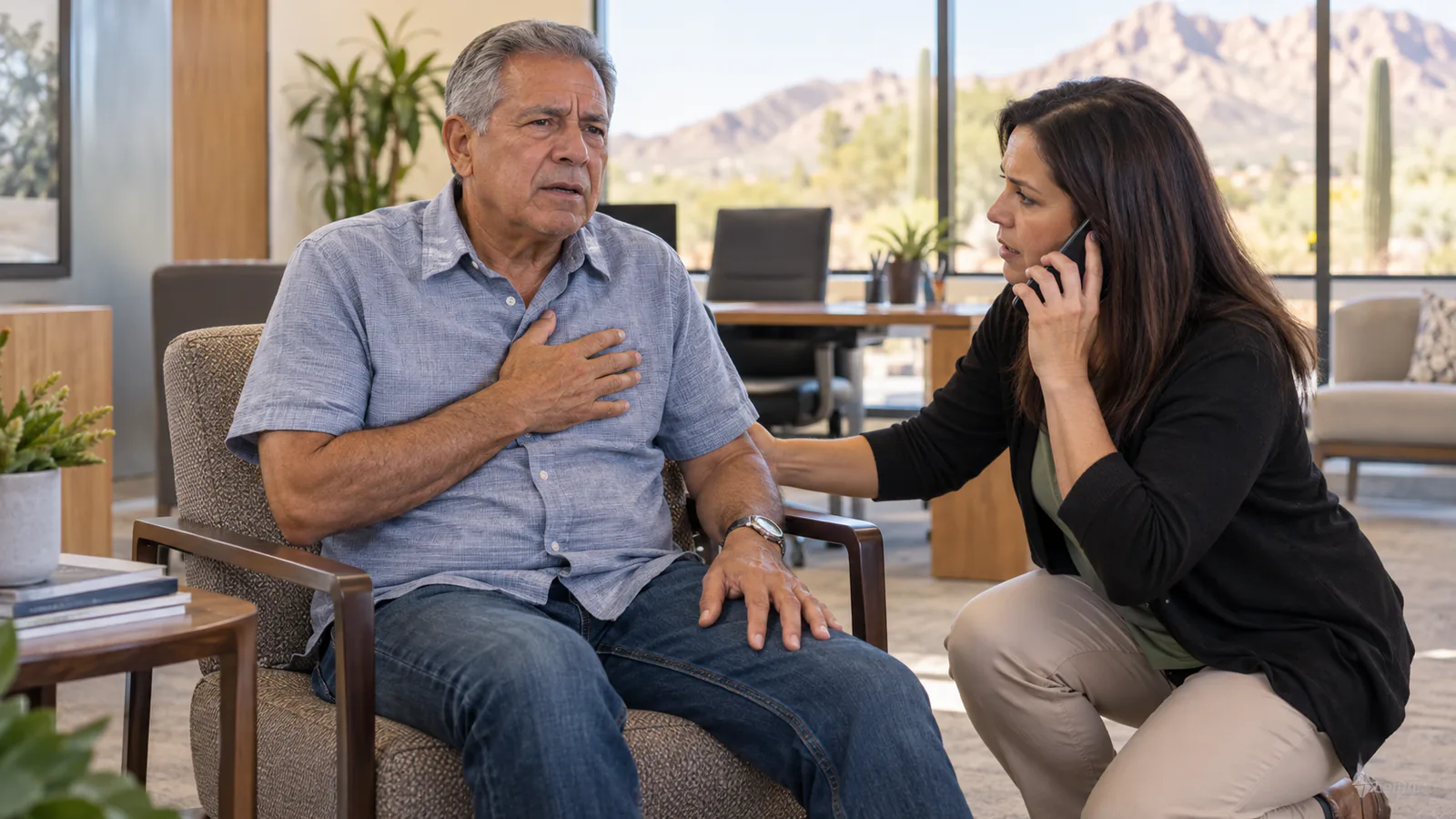
If you think someone is having a heart attack, call 911 right away and send someone for an AED. Keep them calm and resting. Don’t drive them to the hospital yourself.
If they are not allergic to aspirin, don’t have serious bleeding, and don’t show signs of a stroke, have them chew and swallow 1 adult aspirin (325 mg) or 2 to 4 low-dose aspirin (81 mg). If they collapse and stop breathing normally, start CPR and use the AED.
How common are heart attacks?
Very common. About 805,000 people in the United States have a heart attack each year. That is about one every 40 seconds, according to the CDC.
It could be a coworker, a parent at pickup, a volunteer at church, or a family member at home.
What is a heart attack?
A heart attack happens when a blockage cuts off blood flow to part of the heart muscle.
The person is usually awake and talking. That is part of what makes a heart attack easy to brush off. They may say it’s indigestion, or that they just need to sit down for a minute.
What are the signs of a heart attack?
The most common sign is chest discomfort in the center of the chest that lasts more than a few minutes, or goes away and comes back. It often feels like pressure, squeezing, or fullness, or even heartburn, not sharp pain.
Other signs include:
- Discomfort in one or both arms, the upper back, neck, jaw, shoulder, or stomach
- Shortness of breath
- Cold sweat
- Nausea
- Light-headedness
- Unusual tiredness
Chest pain or pressure is always a reason to call 911. You don’t need to be sure it’s a heart attack.
Do heart attack signs look different in women and older adults?
They can. Women, older adults, and people with diabetes may have subtler signs, sometimes with no chest pain at all.
Instead, they might mention shortness of breath, nausea, back or jaw discomfort, or feeling unusually tired. If an older church member or a coworker seems “off” and has any of these signs, don’t wait for chest pain before you take it seriously.
What should I do if someone is having a heart attack?
- Call 911 right away, even if the person says they’re fine. Put the phone on speaker so your hands are free, and stay on the line until the dispatcher says to hang up. Be ready to give the exact location and what is happening.
- Send someone for the first aid kit and an AED. Point at a specific person and tell them to go.
- Keep them calm and resting. Help them sit in a comfortable position and stay with them.
- Give aspirin if it’s safe (see below).
- Watch them closely. If they become unresponsive and stop breathing normally, start CPR and use the AED.
Send someone to meet the ambulance at the door or parking lot. In a large school, church, or campus, this can save precious time.
Why shouldn’t I drive them to the hospital?
It can feel faster to put them in a car and go. But treatment can start in the ambulance, before they ever reach the hospital.
Call 911 and let EMS come to you. Stay with the person and have an AED ready.
Should I give aspirin for a heart attack?
Aspirin can help, as long as it’s safe for that person. Have them chew and swallow:
- 1 adult aspirin (325 mg), or
- 2 to 4 low-dose aspirin (81 mg each)
Don’t give aspirin if the person:
- Is allergic to aspirin
- Has serious bleeding
- Shows signs of a stroke
Why no aspirin for stroke signs? Some strokes are caused by bleeding in the brain, and aspirin can make that bleeding worse. With stroke signs, leave medication decisions to EMS.
Stroke signs include a drooping face, weakness in one arm, or slurred or strange speech. If you see them, call 911 and note the time they started. Our article on stroke signs and what to do explains more.
What if they collapse?
A heart attack can lead to cardiac arrest, where the heart stops pumping blood. The person collapses, doesn’t respond, and stops breathing normally or only gasps.
If that happens:
- Make sure 911 has been called and the AED is on its way.
- Start CPR: push hard and fast in the center of the chest, 100 to 120 times a minute.
- Use the AED as soon as it arrives. Turn it on and follow the voice prompts.
Gasping is not breathing. If you aren’t sure, start CPR anyway. See how to do CPR and how to use an AED for step-by-step help.
A heart attack is not the same as cardiac arrest
A heart attack is a blood flow problem. The person is usually awake and talking. Cardiac arrest is when the heart stops pumping. The person is unresponsive and not breathing normally.
A heart attack can turn into cardiac arrest, which is why you get an AED even while the person is still talking. For more, read What Is an AED and What Does It Actually Do?
This article is general education. It does not replace hands-on CPR and first aid training, where you practice these skills with an instructor.
How LP Health Directions can help
About 350,000 people in the U.S. have a cardiac arrest outside a hospital each year, and about 90% do not survive. Trained bystanders with an AED nearby change those odds.
- CPR and First Aid classes in Phoenix and Tucson, based on the 2025 American Heart Association (AHA) Guidelines
- On-site Group Training for churches, schools, daycares, and workplaces
- AED Solutions for AED sales, leasing, and management, so your building is ready
- More topics in our First Aid Guide
- Ready to get your team trained? Book a class.
Sources
- Centers for Disease Control and Prevention, Heart Disease Facts
- Centers for Disease Control and Prevention, About Heart Attack
- American Heart Association, Warning Signs of a Heart Attack
- American Heart Association, CPR Facts and Updated Guidelines 2025
- American Heart Association, 2025 Guidelines for CPR and Emergency Cardiovascular Care
- American Stroke Association, Stroke Symptoms
Reviewed September 28, 2026. This article provides general education and does not replace first aid and CPR training, medical advice, or 911 guidance.